

Digital Threads & Sentient Systems: Reimagining Infrastructure Intelligence
Presented by Richard Simpson, Founder & Chief Executive, Meta Moto, at ‘Immersive Technologies Driving Industry Transformation: Manufacturing & Construction Showcase’
As manufacturing and construction undergo their most profound transformation since the Industrial Revolution, immersive technologies—VR, AR, MR—are quickly shifting from experimental curiosities to critical infrastructure enablers.
On Thursday, 24 July 2025, the XR Hub at Brisbane’s Precinct in the Fortitude Valley hosted the “Immersive Technologies Driving Industry Transformation: Manufacturing & Construction Showcase”, inviting industry leaders to dive into real-world applications of extended reality and digital twins.
Reimagining Infrastructure Intelligence
The 2025 XR Hub Showcase, held on 24 July at Brisbane’s innovation precinct in Fortitude Valley, brought together over 200 participants from government, industry, and academia to explore how immersive technologies are transforming the manufacturing and construction sectors. The day opened with a keynote provocation that framed the entire event with unusual clarity and depth.
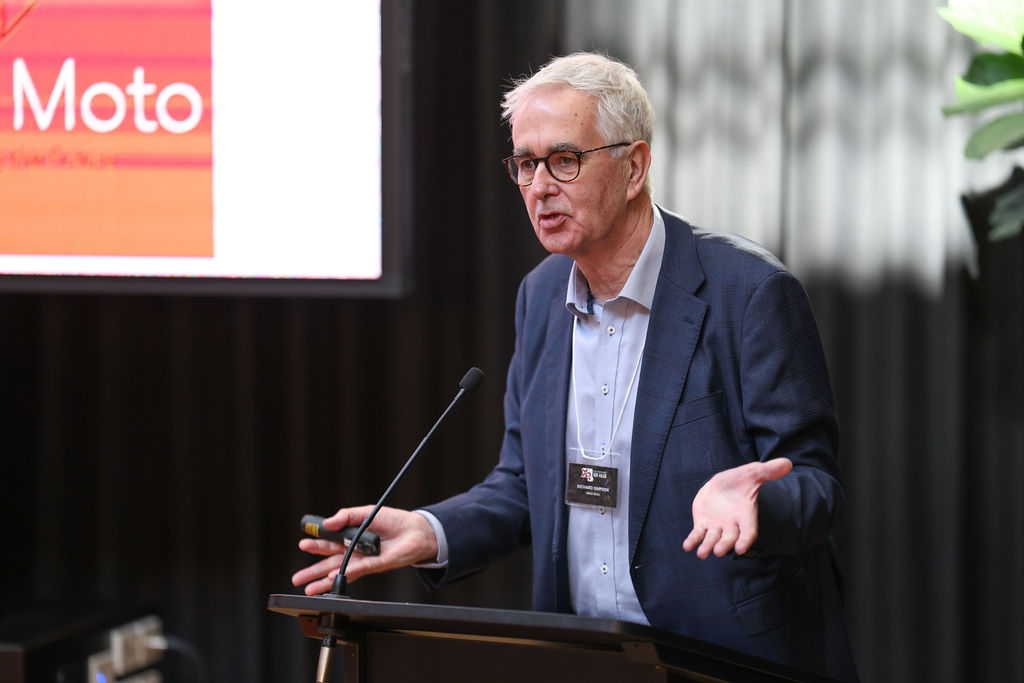
Meta Moto’s Richard Simpson presents at the XR Hub’s Manufacturing & Construction Showcase, 24 July 2025
Titled “Digital Threads and Sentient Systems,” the opening presentation, delivered by Meta Moto CEO Richard Simpson, challenged attendees to rethink immersive technologies not as visual novelties but as critical components of 21st-century infrastructure. Extended reality, it was argued, is rapidly evolving into a civic interface through which we interact with systems that govern everything from energy and mobility to resilience and security. The opening question, “What if our infrastructure could learn?”, reframed XR as a bridge between the physical and digital, capable of sensing, adapting, and evolving.
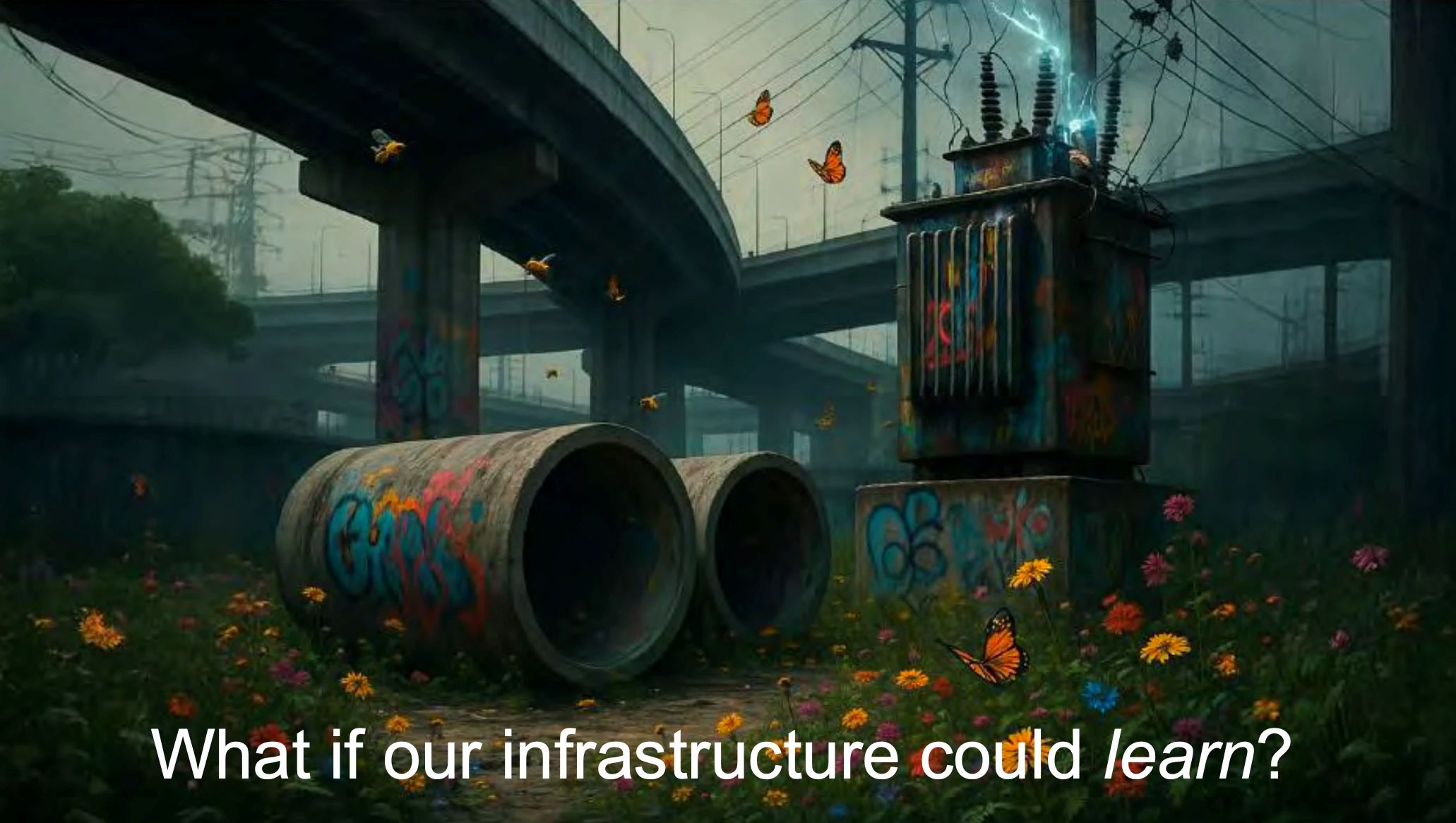
Source: Presentation by Meta Moto’s Richard Simpson at the XR Hub’s Manufacturing & Construction Showcase, 24 July 2025
As digital twins become commonplace in public discourse, many remain static, visual-centric, and disconnected from operational reality. The provocation urged a shift toward systems that are self-healing, certifiable, and interoperable across domains. To support this, Meta Moto has developed a ten-stage maturity model that defines a progression from basic 3D representations to fully integrated, regulatory-grade digital ecosystems. Each stage marks a step toward operational intelligence that is not only technically sound but socially accountable.
One of the most compelling themes was the critique of what were termed “cargo cults” in digital transformation initiatives that perform the rituals of innovation without delivering its substance. Without shared benchmarks, meaningful oversight, and strategic pathways to maturity, many efforts risk becoming digital theatre rather than infrastructure reform.
The presentation also offered a glimpse into practical advancements. Among them was the work of Kea Aerospace, whose solar-powered stratospheric aircraft are designed to provide persistent, high-resolution data streams for urban digital twins. These platforms, flying above weather systems, will enable cities to respond to disruptions, optimise resource use, and even ‘self-heal’ in real-time. This isn’t speculative. It’s an emerging operational reality grounded in the convergence of aerospace, spatial analytics, and digital engineering.
But perhaps the most provocative dimension lay in the introduction of sentient systems – digital infrastructures capable of making context-aware decisions. If digital threads are the nervous system, then sentient systems are described as the awakening brain. The challenge posed was not just about performance or efficiency, but about ethics. How do we teach a sentient system to prioritise safety over profit? To explain its decisions? To act accountably in the absence of human oversight?
Here, the provocation cut to the heart of the matter. This is no longer simply an engineering task. It is a societal one. Governance, transparency, and legitimacy must now be embedded in the architecture of digital systems that will increasingly shape public life. This includes decisions about mobility, health, housing, and resource allocation. These are domains where the stakes are high and the margin for error is increasingly narrow.
To offer a coherent structure for planetary-scale action, the presentation introduced the Digital Earth Framework, comprising twelve interconnected conceptual models grouped into three tiers: foundational systems, enabling infrastructures, and human-centric applications. These include concepts such as Digital Earth as a Cyber-Physical Continuum, a Meta-Design Space for Planetary Futures, and a Strategic Intelligence Theatre, each providing pathways for integrating immersive technologies with ethical governance and sustainable development goals.
The presentation concluded with a nod to Enlightenment thinkers Immanuel Kant and Leonhard Euler, whose theories of spatial cognition and graph structure continue to inform how we design and manage interconnected systems today. It was a reminder that infrastructure is not only about technology—it is about how we perceive, relate to, and steward the world around us.
In many respects, this opening provocation served as both a challenge and an invitation. It called on participants to move beyond pilot projects and platform demos toward deeper conversations about legitimacy, resilience, and planetary coordination. XR is not the solution in itself—it is the interface. The real opportunity lies in what it connects and activates.
For organisations seeking to build systems that are trustworthy, transparent, and future-ready, the ideas presented at XR Hub 2025 offered more than a glimpse of what is possible. They provided a roadmap for what is necessary.

ABOUT RICHARD SIMPSON
With over a decade of experience as the Founding Director and CEO of Meta Moto, a leading provider of strategic management, project management, and technology consulting services, Richard is a passionate and visionary leader who thrives on delivering innovative and impactful solutions for complex challenges.
Richard aims to leverage his expertise in digital twin, smart cities, BIM and spatial data infrastructures to help government and industry sectors improve their planning, decision-making, and performance for societal, economic and environmental well-being.
ABOUT META MOTO
Meta Moto is a globally recognised consultancy specialising in digital engineering, strategic foresight, and the implementation of next-generation digital twin frameworks. With deep expertise in infrastructure, geospatial intelligence, and data-driven transformation, Meta Moto partners with governments, industry, and academia to deliver measurable outcomes and enduring public value. Our advisory services are independent, evidence-based, and grounded in international best practice.